Forest setting
Mitai Māori Village
Waka, haka, hāngī, glowworms
- LengthAbout 3 hours
- SettingIndoors and bush
- AgesAll ages
Packing and prep checklist
Mitai Maori Village: Cultural Experience and Dinner Buffet
★ 4.7 · 4,089 written reviews
Answer in brief
Māori village tours in Rotorua are either evenings with a welcome, haka and hāngī, at Mitai, Te Pā Tū or Te Puia, or daytime visits to Te Puia and the living village of Whakarewarewa.
Know before you go
Prep list · 11 items
Check off each item as you go. Your progress stays saved on this device.
0 / 11 ready
That is everything. Pick your add-on and your date: the rest of the day is planned for you.
Book a seatMāori village tours in Rotorua range from a hāngī evening in the forest to a guided walk through a village where families still live. Here is what each one offers, the history behind them and the customs worth knowing.
Editorial team, rotoruadaytrip.com · Updated November 8, 2026 · 7 mins to read
Rotorua belongs to Te Arawa, and RotoruaNZ calls it a centre of Māori arts, culture and learning, something the city wears openly.1 It was the first city in New Zealand to become officially bilingual, so street signs and greetings switch easily between te reo Māori and English.8 Tourism New Zealand counts over 100 iwi across the country, each with its own stories, and here the stories belong to the Te Arawa tribes.9
The lakeside village of Ōhinemutu was settled by Ngāti Whakaue, of the Te Arawa waka that sailed from Hawaiiki around 1350 AD.10 Ngāti Whakaue later gifted the ground the city now stands on.11 Government Gardens has a similar origin: local iwi gifted 50 acres to the Crown in the late 1800s, land that held hot pools used for healing.12
This is why Māori village tours in Rotorua feel different from a show elsewhere. You are on tribal land, often hosted by the descendants of the people whose names are on the meeting houses. RotoruaNZ describes how Te Arawa, with their tikanga (traditions), beliefs and cultural practices, shaped the identity of the city.13 Curiosity and good manners are how a guest repays that welcome.
Compare the experiences
| Experience | When | Length | Food |
|---|---|---|---|
| Mitai Māori Village | Evening | About 3 hours | Hāngī buffet |
| Te Pā Tū | Evening | 3.5 hours | Hāngī feast |
| Te Puia Te Pō | Evening | 2.5 hours | Dinner |
| Te Puia Te Rā | Daytime | 1.5 hours | Lunch in the combo |
| Whakarewarewa tour | Daytime | 1 hour | Hāngī meal to add |
| Ōhinemutu | Any time | Short walk | None |
Lengths from the listings and the hosts' own pages; Te Pā Tū's own page describes its event as four hours.2,5,26,27
Māori tourism in Rotorua is older than you might expect. Missionaries and traders reached the region in the early 1830s, and word of its geothermal wonders spread among Europeans.14 Local Māori saw the opportunity and began guiding visitors, above all to the Pink and White Terraces. Two famous early guides were Sophia Hinerangi, known as Guide Sophia, and Keita Middlemass, known as Guide Kate.19
Tourists paid 15 shillings per party, which RotoruaNZ calls the birth of modern tourism in New Zealand.20 In 1870 Prince Alfred, Duke of Edinburgh, arrived in the country promoting tourism and trout fishing, and the attention grew.15 Then on 10 June 1886 Mt Tarawera erupted and destroyed the Pink and White Terraces.16 The people affected moved to Rotorua and settled in the thermal valley of Te Whakarewarewa.21
Women of the Tūhourangi and Ngāti Wāhiao hapū traditionally led the guiding at Whakarewarewa.22 Visitors in the 1880s paid two shillings and sixpence, and guides would carry them across the Pūārenga stream for another sixpence.23,24 Guide Sophia kept working until she retired in 1890.17 By the turn of the century the government controlled most sightseeing areas, but the village of Whakarewarewa itself stayed in the hands of its own people.25
The classic Māori tour in Rotorua is an evening, and a handful of hosts lead the way. Mitai Māori Village is family owned and its evening runs about 3 hours.33,2 Warriors in traditional dress paddle a waka down the Wai-o-whiro stream, and the night includes a performance, haka, a hāngī dinner and a guided bush walk to see glowworms in the wild.29,3 The performance and the buffet are both indoors, so rain does not spoil it.34
Te Pā Tū takes you back to a pre-European Māori village.35 It presents culture and kai across four hours, with ceremony, performance and a hāngī meal from an earth oven.27,36 The listing for it notes gluten-free and vegetarian needs can be met but the kitchen is not coeliac-approved, and no cash is taken on the night. Guests gather first at 1220 Hinemaru Street.
Te Puia offers its own evening, Te Pō, with a cultural performance and dinner in the geothermal valley; the listing runs 2.5 hours. In the colder seasons Te Puia adds Mārama, a night-time walk through the valley.37 Mitai, the most reviewed of these listings on this page, advises booking ahead at weekends, in holidays and in peak seasons.38 Whichever you pick, arrive hungry: the meal is a big part of the welcome.
Find your fit
Start with your time in Rotorua, then what you want from the night.
If I only have a day from Auckland
Te Puia add-on
If I want dinner, haka and glowworms
Mitai
If I want a long, immersive night
Te Pā Tū
Culture and kai across four hours.27
If I want to see daily life
Whakarewarewa
Families cook and bathe with geothermal heat.30
If I want something free
Ōhinemutu
Walk the village respectfully at no charge.31
Three evenings to choose from
Forest setting
Waka, haka, hāngī, glowworms
Theatrical night
A pre-European village
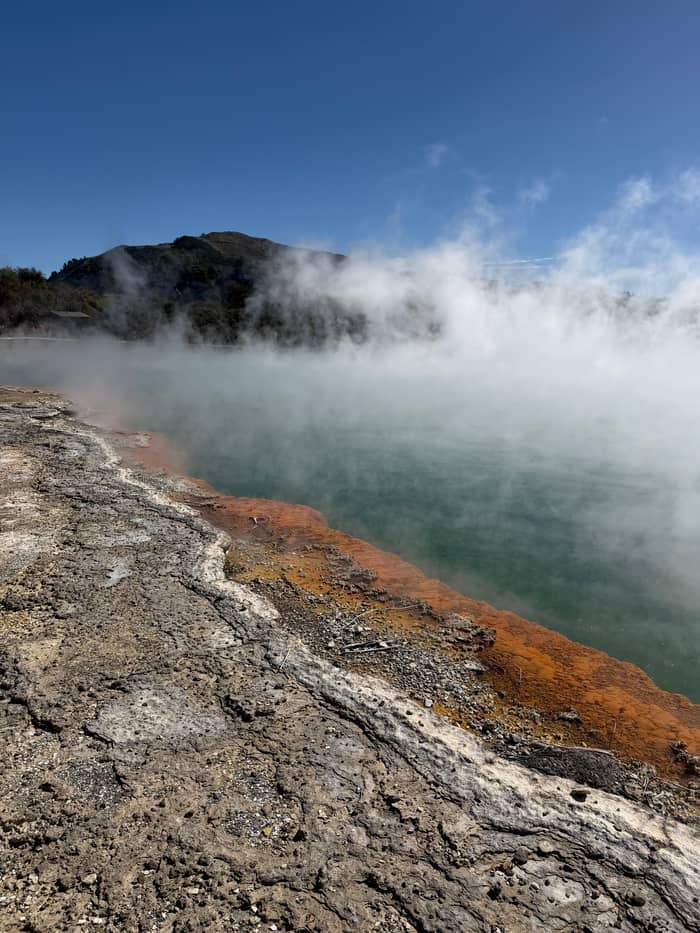
Geyser valley
Evening in the geyser valley
An evening village does not fit a day trip from Auckland, because the drive home leaves in the afternoon. The daytime options do. Te Puia is one of the five add-ons on the tour this site sells, and every daytime visit there is guided.4 At Te Puia you can watch master carvers and weavers at work in the national carving and weaving school, as well as see the Pōhutu Geyser.28
Te Puia is iwi owned.43 Its Te Rā + Haka combo adds a welcome ceremony, songs, chants, poi and haka inside a carved meeting house.44 Next door, Whakarewarewa runs guided village tours of 1 hour from 9am to 3pm and a 30-minute cultural performance at 12.30pm daily.5,45 Its performance tells the village's stories through song, dance and stick games.46
Ōhinemutu costs nothing to visit. You may walk through the village, past steaming vents and the meeting house Tamatekapua, which is admired from outside and not open to the public.31,47 Opposite the marae, St Faith church has a window etched with Jesus wearing a Māori cloak, and entry is NZD 7.50 per person.48,49 Keep to the footpaths: this is a home, not a museum.50
Compare the prices
Choose your group size and compare evenings and day visits side by side.
Compare 4 side by side
Choose your group size and compare evenings and day visits side by side.
≈
View≈
View≈
View≈
ViewGetYourGuide's starting prices, converted at the ECB reference rate; exact pricing appears when you book.
A short history
About 1350
Ngāti Whakaue of the Te Arawa waka settle Ōhinemutu.10
1830s
Missionaries and traders reach the region.14
1870
Prince Alfred promotes tourism and trout fishing.15
1886
The Pink and White Terraces are destroyed.16
1890
The most famous guide steps down.17
Today
Whakarewarewa is still run by its residents.18
Most evening villages open with a pōwhiri, a Māori welcome ceremony that brings formal speeches, singing and food.6 It may begin with a challenge, where a warrior places a token, often a small branch, on the ground, and the visitors pick it up to signal that they come in peace.40 Listen carefully when the hosts explain what is about to happen, and keep still while the challenge is under way.
Then come the speeches. Everyone stays standing until the hosts signal that it is time to sit.39 On a marae the visiting side offers a koha, a gift placed in front of the hosts, as thanks for their hospitality.51 Towards the end comes the hongi: a handshake and a gentle pressing of noses, sometimes with a kiss on the cheek, that shares the breath of life.41 Follow your hosts, and do not rush it.
After the formal part, food is shared. Tourism New Zealand explains that guests are fed first as a sign of respect, then elders and children, then the other adults.52 A first-time visitor to a marae is called waewae tapu, sacred feet, and the welcome lifts that tapu so guest and host become one people for the occasion.53 Knowing this turns a show into a meaning you can follow.
Video
Jessie Carr on YouTube · Tap play to load the video; not before.
A wharenui resembles the human body in structure and usually represents a particular ancestor of the tribe.
A hāngī is an earth oven: food is cooked by steam and heat from stones heated first.54 In the usual method a hole is dug and hot stones go in at the bottom before the meat and root vegetables.55 At Whakarewarewa the steam vents and a hot pool do the work instead, cooking beef, chicken, potato, sweet potato, corn and vegetables for the geothermal hāngī meal.56 Tasting corn cooked in the village's largest hot pool is part of the guided tour.57,58
Haka is not one dance. Tourism New Zealand explains that haka varies by tribal region, with many telling of significant events in an iwi history, and that today it represents mana (prestige) and respect.59,60 Watch the faces and hands as well as the feet. If you are invited to join in, do it wholeheartedly; laughing at the actions misses the point of them.
The wharenui, or carved meeting house, resembles a human body and usually represents an ancestor of the tribe.32 If you are invited inside, take your shoes off, do not eat or drink, and always ask before taking photos.7 Marae are the focal point of Māori communities, and you cannot walk onto one without being formally welcomed by its people.61,42
If you are in Rotorua for the evening, an evening village gives the fullest picture: welcome, performance, hāngī and, at Mitai, glowworms in the bush.3 The Mitai listing on this page is the one with the most reviews and runs about 3 hours. Te Pā Tū suits those who want a longer, more theatrical night, which its listing puts at 3.5 hours and the venue's own page at four.27 Both include a meal, so skip a big dinner beforehand.
On a day trip from Auckland the daytime options are the realistic ones. Choose Te Puia as your add-on for the carving institute, the geyser and a guided walk, or book a Whakarewarewa village tour of 1 hour to meet the people who live on the steam field.5 The village performance at 12.30pm daily slots in neatly around lunch.45
With children, every option works: the Mitai listing is marked suitable for all ages, and Whakarewarewa admits under-fives free.62 For those with mobility needs, Te Pā Tū and the Whakarewarewa village tour listings are marked wheelchair accessible. Whatever you book, the same manners apply: listen, follow the hosts, and keep your phone down during the welcome.
FAQ
Pick Te Puia as your add-on, or join a 1 hour Whakarewarewa village tour.5
Food is cooked with steam and heat from heated stones.54
Always ask before taking photos, and remove your shoes before entering.7
Both the performance and the hāngī buffet are presented indoors.34
Sources
Further reading
Weighing up a day in Rotorua from Auckland? A real person answers here.