Self-guided
Wai-O-Tapu ticket
Explore at your own pace
- EntryAny time in opening hours
- Last entry3pm
- Best forDrivers
Decide with ease
Rotorua: Wai-O-Tapu Geothermal Park Entry Ticket
★ 4.6 · 3,146 written reviews
Answer in brief
For geothermal tours in Rotorua, pick Wai-O-Tapu for colour, Te Puia for the Pōhutu Geyser, Waimangu for a quiet valley walk, Hell's Gate for a mud bath and Orakei Korako for a boat to the terraces.
Good to know
Two questions, one steam field
Say how you want to travel and what you most want to see, and the matching ticket or tour appears with its starting price.
Best choice for you
from $28
Walk the colour park at your own pace, any time between 8:30am and the 3pm last entry.
Best choice for you
from $108
5 hours from Rotorua hotels: 1 hour guided at each park, plus the Lady Knox Geyser.
Best choice for you
from $68
3 hours with a guided walk and the mud bath, 20 minutes per person.
Best choice for you
from $55
1.5 hours with a guide through the geyser valley of Te Puia.
Best choice for you
from $33
1 hour with a village guide, groups of up to 20, Pōhutu from two viewing platforms.
Geothermal tours in Rotorua lead to very different parks. One has the famous orange-rimmed pool, one a geyser that plays all day, one a valley born in 1886, one a mud bath. Here is how they compare.
Editorial team, rotoruadaytrip.com · Updated November 8, 2026 · 8 mins to read
Tourism New Zealand sums Rotorua up in a phrase: the city is famous for its geothermal sights.6 What surprises first-time visitors is how different the parks feel from each other. Some are about colour, some about a single geyser, some about history and one about lying in warm mud. Waimangu, one of the parks, even recommends seeing more than one, because the features vary so much from field to field.7
The usual geothermal tours in Rotorua visit Wai-O-Tapu, south of the city, which is also the morning stop of the day trip from Auckland that this site sells. Te Puia and Whakarewarewa share the Whakarewarewa valley on the southern edge of town, Waimangu and Wai-O-Tapu sit on the road to Taupo, Hell's Gate lies to the north-east at Tikitere, and Orakei Korako hides further south on the Waikato River.
If you book a Rotorua volcano tour rather than driving, the guide makes these choices for you; otherwise choosing comes down to a few questions. Do you want colour or a big eruption? Do you want culture alongside the steam, or simply nature? And how much time is left after the drive? Read the sections below with those questions in mind, then use the table and the decision rows to narrow it to one or two parks. A half day is enough for one park at an easy pace; packing several into a day leaves little time to stand and watch.
Side by side
| Park | Known for | From Rotorua | Adult entry |
|---|---|---|---|
| Wai-O-Tapu | Champagne Pool, Lady Knox | 31km, 27 min | Ticket below |
| Te Puia | Pōhutu Geyser, kiwi, carving | In town | NZD 105 guided |
| Whakarewarewa | Living village | In town | NZD 58 guided |
| Waimangu | Valley born in 1886 | 25 min | NZD 135 with cruise |
| Hell's Gate | Mud bath, hot waterfall | Tikitere | Ticket below |
| Orakei Korako | Terraces, cave, boat | 45 min | NZD 63 |
Entry fees in New Zealand dollars as each park publishes them; distances from the parks' own pages.20,23,24,25,26,27,28
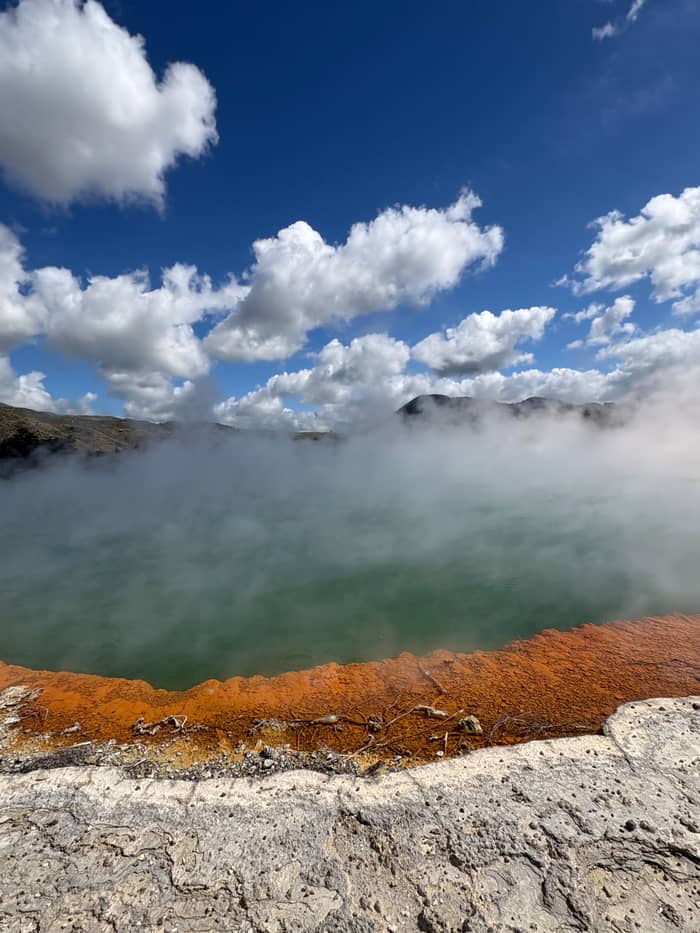
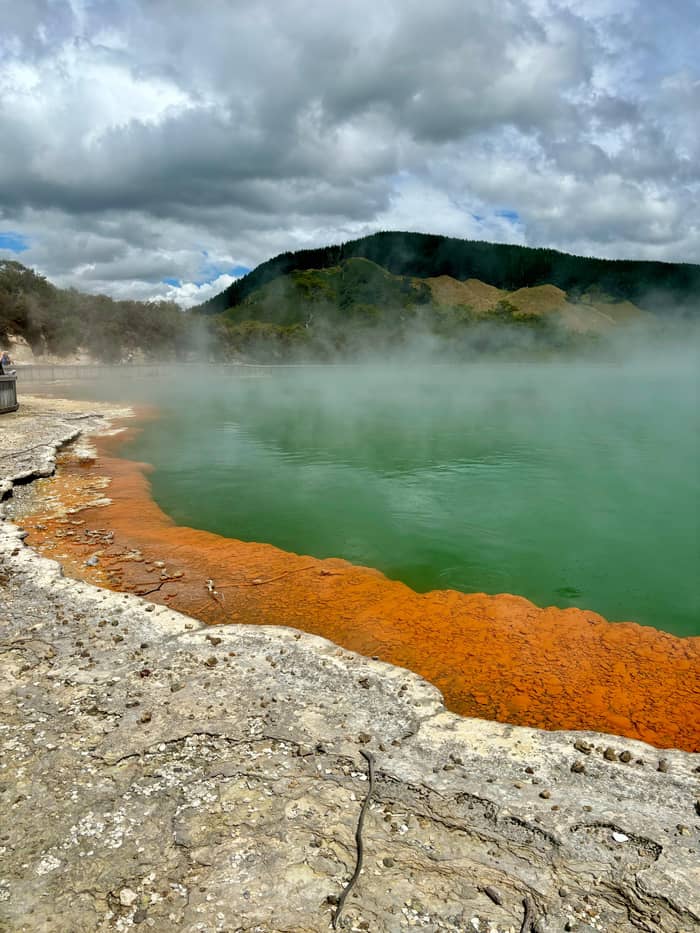
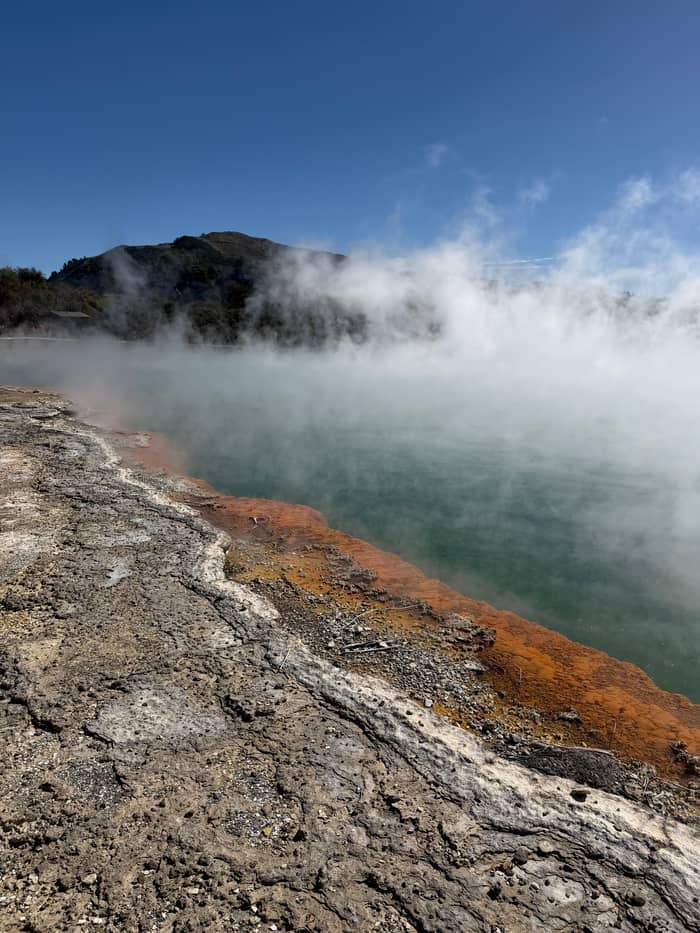
Wai-O-Tapu is the park for colour. It sits on 18 square kilometres of live geothermal ground at the northern rim of the Reporoa Caldera, a collapse that happened 230,000 years ago.8 Its marked tracks wind past coloured hot and cold springs, steaming caves, wide craters, sinter terraces and the Champagne Pool, which steams under its orange rim on cool mornings.1 The park says its Mud Pool is the largest in New Zealand, on the site of an old mud volcano.14
The Lady Knox Geyser is the park's other draw, presented daily at 10.15am at its own site, a short drive from the visitor centre.15,16 Because the eruption is set for a time, it rewards an early start. The rest of the park opens at 8:30am and takes its last admission at 3pm, so a morning visit fits most plans.17 Wai-O-Tapu is a cashless site that takes cards and EFTPOS only.18
The guide map handed out with each ticket is printed in many languages, German, Dutch, Japanese, Korean and Czech among them, which helps mixed groups.19 Wai-O-Tapu is 31km and 27 minutes from Rotorua by road.20 A plain entry ticket suits travellers with a car who want to set their own pace and linger at the pools they like best.
For a big eruption, head to the Whakarewarewa valley. Its star is Pōhutu, which Te Puia calls the largest active geyser in the Southern Hemisphere: it can reach 30 metres.2 A Te Puia ticket covers the geyser valley, the kiwi centre and the national school for carving and weaving, and every daytime visit there is guided.33,34
Te Puia is iwi owned and sits at 20 Hemo Road on the southern edge of town.35,36 Its Te Rā guided experience costs NZD 105, and the combo with a haka performance NZD 142.23 Next door, Whakarewarewa is a living Māori village where families still cook, bathe and heat their homes with geothermal energy.29 Its 1 hour guided tour views Pōhutu from the village side and costs NZD 58 for an adult.37,38,24
The difference matters. Te Puia is the bigger attraction, with the arts institute and kiwi house, while Whakarewarewa is a home where the guides are descendants of the people who started guiding here.39 The village also runs its own self-guided trails, but they do not reach Pōhutu Geyser.40 Pick Te Puia for the full geyser view and the carvers, the village for daily life on the steam field; see our Whakarewarewa guide for the village in detail.
Three ways to see the steam
Self-guided
Explore at your own pace
Guided
Wai-O-Tapu and Waimangu
Hands-on
Hell's Gate at Tikitere
Waimangu is the youngest of the parks and the one with the strongest story. The 1886 eruption of Mount Tarawera made this valley, while the other geothermal areas nearby are thousands of years old.3 The park says it is the only example of a native New Zealand ecosystem that regrew after being destroyed by a volcanic event, and that it is quieter than other attractions.46,47
The walks drop gently through the valley and range from 1.5km to 4.5km.30 On the way you pass Frying Pan Lake, which the park ranks as the world's largest hot water spring measured by surface, and Inferno Crater Lake, a huge geyser-like spring.48,49 Oddly, the outflows of Frying Pan Lake and Inferno Crater rise and fall in opposite directions, one swelling as the other drops.50 A magma chamber about 2.0km below the valley drives it all.51
The Full Waimangu Experience adds a fully guided 45 minute cruise on Lake Rotomahana, where the Pink and White Terraces stood before 1886, and costs NZD 135.31,12,25 Allow 3+ hours, and arrive before the last admission for it at 1.30pm.52,53 Waimangu is about a 25-minute drive from central Rotorua and is completely cashless.26,43 There are no toilets on the boat, so plan ahead.54
Compare the options
Choose your group size and compare tickets and tours side by side.
Compare 4 side by side
Choose your group size and compare tickets and tours side by side.
≈
View≈
View≈
View≈
ViewGetYourGuide's starting prices, converted at the ECB reference rate; exact pricing appears when you book.
How the land was made
230,000 years ago
The collapse that framed the Wai-O-Tapu field.8
131AD
An earthquake formed the upper terraces at Orakei Korako.9,10
1325
By the village's own account, Te Arawa people first occupied the valley.11
1886
The eruption created Waimangu and buried the Pink and White Terraces.3,12
1934
George Bernard Shaw visited Tikitere.13
Hell's Gate, at 351 State Highway 30 in Tikitere, is the park where you get into the earth rather than just look at it.4 Alongside its steaming walk it runs a mud bath and sulphur spa, and it says it has the largest hot waterfall in the Southern Hemisphere.55 The native bush around the reserve is home to Kakahi Falls, which is significant to local Māori.56,57 Its mud and waters have been used for over 800 years.58
The mud bath has a firm limit of 20 minutes per person per day, set for health and safety reasons after consultation with health professionals and Kaumātua, respected elders.59 The pools run from 37 to 41 degrees depending on the season and the day.60 Leave your rings and chains behind: the park warns that its muds and waters tarnish most jewellery, silver especially.61 Bring old swimwear, since the sulphur smell clings to it.
Rain is no reason to cancel. The park says wet weather brings a noticeable increase in activity and steam across the reserve.42 It opens daily at 10:00am, later than Wai-O-Tapu and Waimangu at 8.30am, which makes it a good afternoon stop.62,63 The playwright George Bernard Shaw visited in 1934, and after his visit local Māori chose Hell's Gate as the English name for the area.13,64 It is the obvious pick if your group wants a soak more than a long walk.
Video
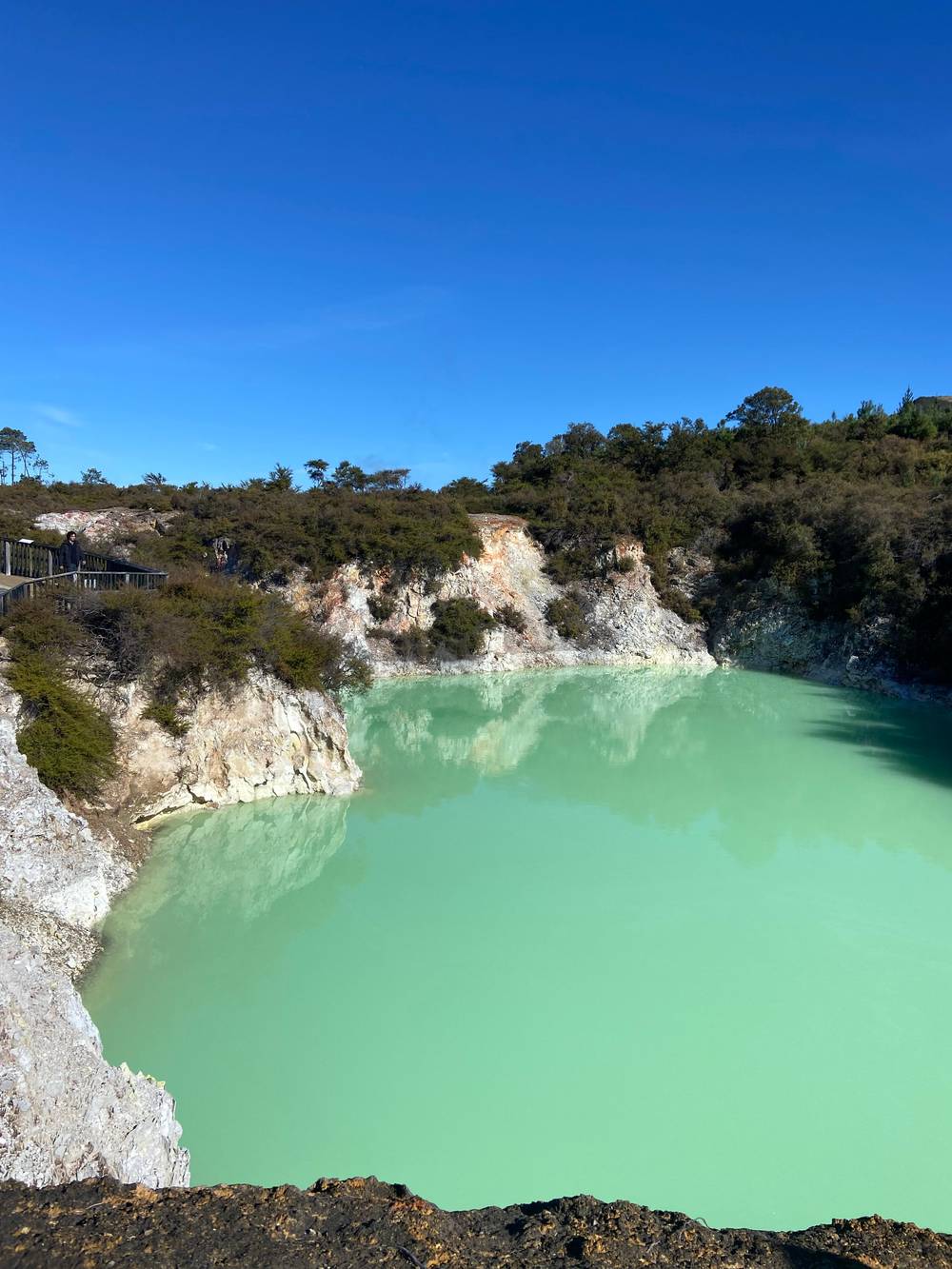
Virtual Journeys with Michael Nees on YouTube · Tap play to load the video; not before.
Waimangu was created by the eruption of Mount Tarawera in 1886, whereas other geothermal attractions in the area have been around for thousands of years.
Before the boardwalk
Orakei Korako is the one you reach by boat. The geothermal field sits across the water from the visitor centre and can only be reached by the short ferry, which runs on demand from 8am, and the final crossing to the valley leaves at 4pm.5,65 Admission is NZD 63 for an adult and NZD 25 for a child, with the crossing included.27,66 The drive from Rotorua takes about 45 minutes, so it pairs naturally with a trip towards Taupo.28
When the hydro lake was filled, the Waikato River at Orakei Korako rose by 18m and flooded more than 250 hot springs and geysers.67 What remains is still striking: silica terraces, including the Golden Fleece Terrace at 40m long and 5m high, and Diamond Geyser, which throws water up to 9 metres into the air.9,22 Ruatapu Cave drops more than 35m to a warm pool at the bottom.68
RotoruaNZ calls Ruatapu one of only two geothermal caves known in the world.69 The self-guided walk is mostly boardwalk and usually takes 1 - 2 hours at an easy pace, but it has several steps, so it does not suit a wheelchair or a stroller.70,45 Its distance from the city keeps it calm, which is part of its charm on a busy summer day.
Every park asks the same of you. At Wai-O-Tapu visitors must follow the marked tracks, stay behind barriers, obey the signs and keep children with an adult.44 At Waimangu you are responsible for your own safety and are asked to stay on the path at all times.71,72 Geothermal ground can look solid when it is not, and water that looks calm can be near boiling, so never step off a boardwalk for a better photo.
Wear closed shoes with grip; Wai-O-Tapu turns down open footwear and heels for its tracks.41 Drones are not allowed there.73 Expect the smell: Rotorua smells of sulphur from the hydrogen sulphide released by geothermal activity, and how strong it is changes with the weather.74,75
Rotorua geyser tours from the city usually bundle two parks, often Wai-O-Tapu with Waimangu, and handle the driving and tickets for you. One morning tour listed here spends 1 hour guided at each park with a stop for the Lady Knox Geyser. If you have a car, single tickets give you more time where you want it. Either way, keep the day to a couple of parks so there is time to stand and watch the water move.
FAQ
Its tracks pass coloured springs, craters, sinter terraces and the Champagne Pool.1
Te Puia says it can reach 30 metres.2
It was formed in 1886, when Mount Tarawera erupted.3
The park limits the mud bath to 20 minutes per person per day.32
Wai-O-Tapu asks that children stay with an adult and that everyone keeps to the marked tracks.44
Sources
Further reading
Weighing up a day in Rotorua from Auckland? A real person answers here.